Monday, 6 April 2015

"To be" idioms


Retrieved from: 
http://languagelearningbase.com/86877/to-be-idioms
on April 6, 2015

Causative verbs: help, let, make, have and get

Causative verbs show us that some person or thing helps to make something happen; they express what causes an action to happen. 
Here are some examples of how causative verbs work in English:


Retrieved from: 
http://languagelearningbase.com/86114/causative-verbs-help-let-make-have-and-get
on April 6, 2015

The rules for the use of capital letters and apostrophes

When do we use capital letters in English? When do we use the apostrophes? How many times have you wondered about these problems? 


Retrieved from: 
http://languagelearningbase.com/86153/the-rules-for-the-use-of-capital-letters-and-apostrophes
on April 6, 2015

Informal contractions in English

Contractions are words that are created by combining words in order to shorten them from their original form. They are used when speaking and when writing in casual situations. 
Common contractions are she's (she is), don't (do not), can't (cannot) and won't (will not), among others; and can be written or spoken (informal)
Informal contractions often combine with: you, to, of, would have, etc.
Informal contractions are contractions that break grammar rules and are only used in very casual speech.  


Retrieved from: 
http://languagelearningbase.com/86988/informal-contractions-english-free-spoken-english-lesson
on April 6, 2015

The most popular connective words

Connectives (or connectors) are the words that connect words, clauses, phrases, sentences or even paragraphs. The main connectives are:
  
    - Prepositions: in, on, at, from, etc
    - Conjunctions: and, or, but, etc
    - Relative pronouns: that, which, who, what
    - Conjunctive or relative adverbs: hence, when, where, why, etc


Retrieved from: 
http://languagelearningbase.com/87017/the-most-popular-connective-words
on April 6, 2015

Fifteen familiar terms and their other meanings


Retrieved from:
http://languagelearningbase.com/85020/15-familial-terms-and-their-other-meanings
on April 6, 2015

Tuesday, 31 March 2015

English Perfect Tenses


Retrieved from:
https://www.facebook.com/EnglishIF/photos/pb.384707561542391.-2207520000.1427855260./1004033519609789/?type=3&theater
on March 31, 2015

English Continuous Tenses


Retrieved from: 
https://www.facebook.com/EnglishIF/photos/pb.384707561542391.-2207520000.1427855260./1004033549609786/?type=3&theater
on March 31, 2015

English Simple Tenses


Retrieved from: 
https://www.facebook.com/EnglishIF/photos/pcb.1004033792943095/1004033512943123/?type=1&theater
on March 31, 2015


Difference between Do and Make

MAKE is associated with creation (producing, constructing, creating or building something new, plans or decisions). We use MAKE with food, drinks, meals.
Examples: 

  • I've just made a cake.
  • Can you tell me how much ten and ten make?
  • The dress you are wearing seems to be made for you.
DO is associated with completion (about work, jobs, tasks, activities in general without being specific). They do not produce any physical object. We sometimes use DO to replace a verb when the meaning is clear or obvious. This is more common in informal spoken English. 
Examples: 
  • I must do the shopping.
  • You must do your exercise again. 
List of standard expressions that take the verb DO and MAKE


Retrieved from: 
http://languagelearningbase.com/87095/difference-between-do-and-make
on March 31, 2015

English Modal Verbs

Modal verbs are auxiliary verbs that can only be used with a main verb, they cannot be the main verb. It is used to express modality, that is likelyhood, ability, permission, and obligation.
Examples:
                Can I go to the party?
                Could you read when you were two years old?


Retrieved from: 
http://languagelearningbase.com/85188/english-modal-verbs
on March 31, 2015
Some common verbs in English


Retrieved from: 
https://www.facebook.com/EnglishIF/photos/a.384715731541574.98999.384707561542391/1014090848604056/?type=1&permPage=1 (English is fun)
on March 31, 2015

American slang expressions and their equivalents in British English


Retrieved from: 
http://languagelearningbase.com/79483/american-slang-expression-their-equivalents-british-english
on March 31, 2015

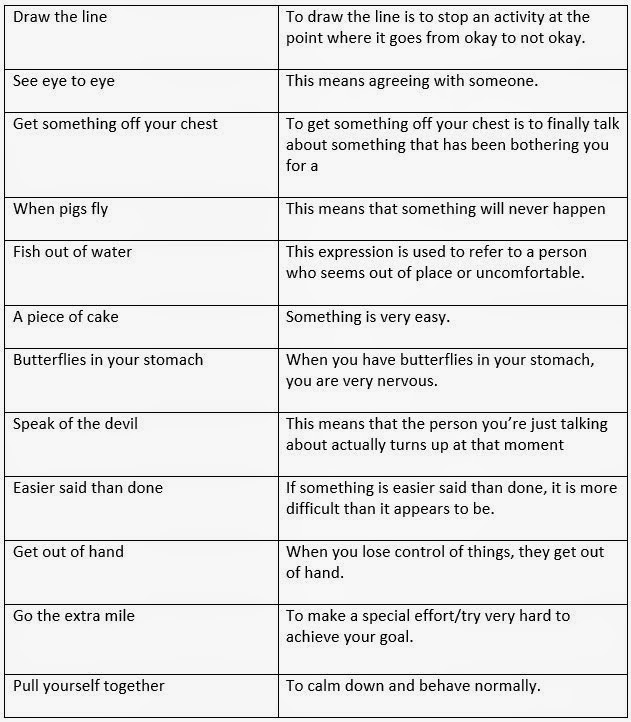
Idioms used in everyday English


Retrieved from:
http://languagelearningbase.com/87116/idioms-used-in-everyday-english
on March 31, 2015

Words and phrases we owe to William Shakespeare


Retrieved from:
http://languagelearningbase.com/87121/words-and-phrases-we-owe-to-william-shakespeare
on March 31, 2015

Wh- questions


Retrieved from:
http://languagelearningbase.com/81614/wh-questions-question-words
on March 31, 2015

Prepositions after adjectives


Retrieved from:
http://languagelearningbase.com/82944/prepositions-after-adjectives
on March 31, 2015

Past Simple Vs Present Perfect


Retrieved from:
http://languagelearningbase.com/85221/past-simple-vs-present-perfect
on March 31, 2015

Idioms with feet


Retrieved from:
http://languagelearningbase.com/87142/idioms-with-feet
on March 31, 2015

History of Easter

Easter, which celebrates Jesus Christ's resurrection from the dead, is Christianity's most important holiday. It has been called a moveable feast because it does not fall on a set date every year, as most holidays do. Instead, Christian churches in the West celebrate Easter on the first Sunday following the full moon after the vernal equinox on March 21. Therefore, Easter is observed anywhere between March 22 and April 25 every year. 
The exact origins of this religious feast day's name are unknown. Some sources claim the word Easter is derived from Eostre, a Teutonic goddess of spring and fertility. Other accounts trace Easter to the Latin term hebdormada alba, or white week, an ancient reference to Easter week and the white clothing donned by people who were baptized during that time. Through a translation error, the term later appeared as esostarum in Old High German, which eventually became Easter in English. In Spanish, Easter is known as Pascua; in French, Paques. These words are derived from the Greek and Latin Pascha or Pasch, for Passover. Jesus' crucifixion and resurrection occurred after he went to Jerusalem to celebrate Passover, the Jewish festival commemorating the ancient Israelites' exodus from slavery in Egypt. Pascha eventually came to mean Easter.
Easter is really an entire season of the Christian church year, as opposed to a single-day observance. Lent, the 40-day period leading up to Easter Sunday, is a time of reflection and penance and represents the 40 days that Jesus spent alone in the wilderness before starting his ministry, a time in which Christians believe he survived various temptations by the devil. The day before Lent, known as Mardi Gras or Fat Tuesday, is a last hurrah of food and fun before the fasting begins. The week preceding Easter is called Holly Week and includes Maundy Thursday, which commemorates Jesus' last supper with his disciples; Good Friday, which honors the day of his crucifixion, and Holy Saturday, which focuses on the transition between the crucifixion and resurrection.
In addition to Easter's religious significance, it also has a commercial side, as evidenced by the mounds of jelly beans and marshmallows chicks that appear in the stores each spring. As with Christmas, over the centuries various folks customs and pagan traditions, including Easter eggs, bunnies, baskets and candy, have become a standard part of this holy holiday. 

Retrieved from:
www.history.com/topics/holiday/history-of-easter
on March 31, 2015